
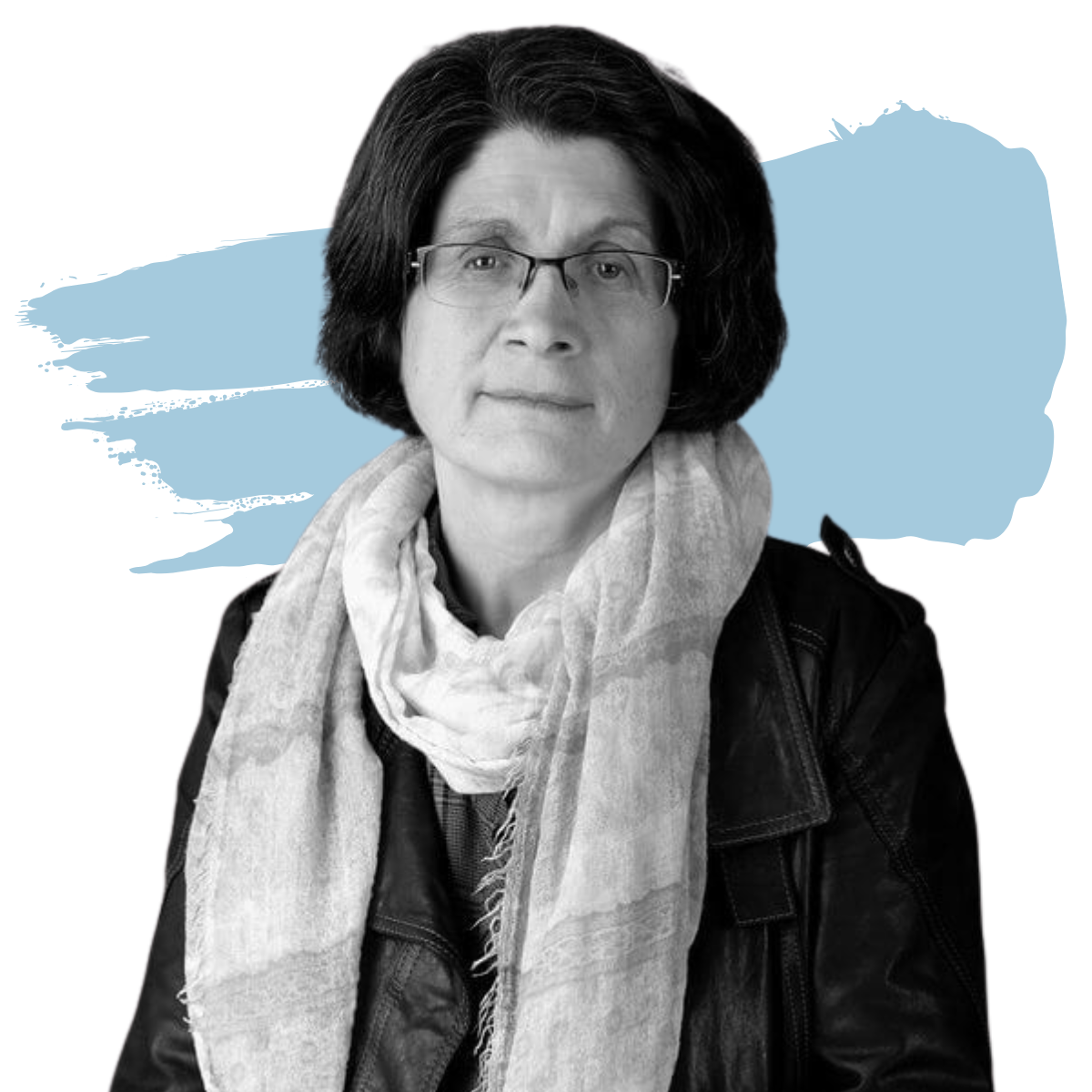
It is a windy October afternoon as students make their way to Lillian’s creative writing class on the UBC campus.
“She creates a safe and nurturing environment to write,” a young female student tells me as we await the teacher’s arrival.
“She gives us structure and feedback,” another student adds.
Just then Lillian enters. She takes off her raincoat, revealing a lavender jacket and matching scarf with comfortable black slacks. Lillian has blonde hair; dark mascara emphasizes her eyes. Among other accomplishments, she is an energetic grandmother of three.
But as Lillian herself would say, it is what lies beneath that matters.
The Old Brown Suitcase is Lillian’s best-known teen story and she has just completed an adult novel. This is her 26th year teaching “Life into Fiction,” a writing course offered through UBC’s continuing education program.
The chairs fill up with six females and a male, ranging in age from 20 to 40-something. To each student Lillian hands back a writing exercise on using metaphor.
Lillian encourages her students to dig deeper in their writing. “You really have to tell the truth,” she says. She coaches them to “open up the interior” of the person. “We are hanging on the outside of our-selves,” she says.
“Life plus imagination,” are the secret ingredients to writing, Lillian believes. “Both are powerful sources.” She mentions a previous assignment on childhood memories. “The dearest and most profound time of our lives,” she calls it.
Today, students will perform dialogues. Enthusiastic group feedback follows each reading. The writing is lively and the process instructive.
Later, I ask Lillian about the highlights of her teaching. “I have a tremendous feeling of satisfaction and of bringing students as people out of themselves,” she says. We are sipping tea in the living room of Lillian’s home, a tastefully furnished apartment enriched with colorful wall paintings and glass art.
Lillian tries to make her students understand they have a right to contemplate their life “because people are brought up to think they don’t have that right.”
“What I have found is that most people are blocked,” she says. “And they do not want to remember things.
Lillian describes an “ache” she felt acutely in the early years of her marriage while raising two children. She was suppressing painful memories of a childhood spent in the Warsaw ghetto during the Nazi occupation and later as a hidden child in the Polish countryside.
“I felt different and I didn’t know any other child survivors then,” she says.
Lillian was conflicted. “I was a very happy-go-lucky, fun-loving blonde individual and inside I was a very sad and very unhappy child.”
“I carried all this stuff for a long, long time,” Lillian says. “I was told to forget the past. The society in which I lived was indifferent, even hostile to the Holocaust.”
The prison of her past became a metaphor for Lillian’s blocked relationships with family.
“I was incarcerated behind the ghetto wall and I remem-ber standing behind the wall and hearing a carousel play and I had typhus and was starving. And I heard children laugh-ing but it was all behind the wall,” she recalls.
“I had scars that had never healed and there was no one to heal them but myself. So that started me writing my prose.
An unusual encounter gave Lillian more insight and encouragement. She agreed to accompany a friend on a prison visit. The inmate turned out to be a refreshing contrast to most people Lillian knew in Vancouver. “We were all raising children,” Lillian explains. “So we talked about brownies and mahjong.”
“He was my mentor,” she says of the man behind bars. “We were able to talk about Kafka and Dostoevsky and you see, I was into those things.”
“He told me I should pursue a career—read a lot and go back to university—and start writing my experiences,” Lillian says.
“He found that part of me that was hidden behind the wall. I came out that way. I couldn’t come out to society but I came out with him and we wrote letters for a while. And that was a great help.”
“He was freer than I was,” Lillian says. “That was what I noticed.”
Language was both a barrier and a gift for Lillian. Her family emigrated to Canada after the war when Lillian was twelve. She learned French in Montreal and later was sent to a girls’ boarding school on Vancouver Island. Already fluent in Polish and Russian, she resisted English.
But when Lillian went back to college, as her mentor suggested, she found a new way of looking at English. She took a UBC writing course taught by poet J. Michael Yates who encouraged her to translate the writings of Polish émigré poets.
“When I started doing that, I discovered that English wasn’t as big a barrier because I could see beautiful Polish poems being formed in English.”
Using her Polish name, Jagna Boraks, she became a translator and began writing a memoir.
A publisher suggested Lillian write a novel for young adults. “So I had to transform a memoir into a novel and I decided to do it in flashbacks. It worked!”
The Old Brown Suitcase, printed in 1994, went on to garner literary awards and is available in hundreds of high schools. The fictional story of Slava Lenski, a child Holocaust survivor, continues in The Sunflower Diary, based on Lillian’s time in boarding school where she faced a “strong identity crisis” as the only Jewish girl among Christians.
Then came The Lenski File following Lillian’s own attempts to find her younger sister who had been hidden by her parents during the war.
“We never knew whether she died for sure and I felt that it was up to me as the eldest daughter (to search for her.)”
Lillian began the search in Poland in the 1960s and has made many trips since.
The teen trilogy ends with unresolved questions and Lillian picks them up again in Mouth of Truth, an adult novel currently making the rounds of publishers.
Two collections of poetry behind her, Lillian is now working on short stories. As a co-founder of a group for child survivors and hidden children at the Vancouver Holocaust Centre, Lillian continues to speak about her childhood experiences in an outreach program for public schools.
“I think the work that remains to be done (about the Holocaust) is the impact that surviving parents have had on their children and on their children’s children,” she says.
The delicious irony of fiction as an art form is its capacity to reveal the truth of our lives. Lillian has seized upon this irony and applied its lessons with her students and in her own work. But a writer’s knowledge is not enough. Character counts.
With quiet emphasis, Lillian leaves me with the mantra she offered earlier to her students: “It takes courage to be a writer—to write the truth.”